The Performance Princess Problem

Modern Dating, Social Media, and the Death of Real Growth
A pointed cultural critique of dating-performance culture, social media validation, and the collapse of real personal development.

Introduction: The Costume of Standards
Let us be precise so the shot actually lands. This is not an attack on women as human beings. This is an attack on a very loud, very online, very curated dating-culture archetype: the woman who has built her entire identity around being desired, pursued, gifted, validated, and entertained, but has not built the emotional discipline, self-awareness, or growth mindset to match the lifestyle she thinks she deserves.
And yes, that archetype is everywhere now. It is on X. It is on TikTok. It is on Instagram. It is in podcast clips. It is in dating advice reels. It is in captions that sound like empowerment but move like entitlement. It is in comment sections where people say, “Know your worth,” when half the time what they really mean is, “Overprice yourself and call it standards.”
Nasty work.
The issue is not that women have standards. Standards are necessary. The issue is when standards become a costume for emotional laziness, financial fantasy, and social media theater. That is where modern dating starts looking less like relationship-building and more like brand management.
Modern Dating Has Turned Into a Performance Economy
Modern dating is no longer just about compatibility, values, patience, timing, maturity, or building something real with another person. Now it is a stage. Aesthetic first. Character later. Screenshots first. Self-reflection never. Soft life first. Accountability missing.
Online dating has made this even more complicated. Pew Research Center reported in 2023 that 30% of U.S. adults had used a dating site or app, and that online dating was especially common among younger adults. Pew also reported that women and men experience the online dating market differently: among current or recent online daters, 54% of women said they felt overwhelmed by the number of messages they received, compared with 25% of men.
That matters because abundance changes behavior. When a person receives constant options, constant messages, constant compliments, constant “you’re beautiful,” constant “wyd,” and constant offers of attention, it can create a false sense of market value. Not relationship value. Not character value. Not growth value. Market value.
And market value is dangerous when it starts replacing self-development. Because now a person does not have to become better. They just have to stay desirable. That is the trap.
Being Wanted Is Not the Same as Being Developed
This is where professional development enters the room and slams the folder on the table. Real growth requires friction. Real growth requires hearing no. Real growth requires being corrected without collapsing. Real growth requires starting from nothing, learning the basics, failing publicly, rebuilding privately, and becoming somebody more disciplined than the version of you that wanted instant applause.
Stanford’s Center for Teaching and Learning describes growth mindset as the ability to reframe perceived failures as opportunities to learn and grow. That definition matters because it separates real development from polished performance. Growth is not a caption. Growth is not a selfie. Growth is not a luxury dinner with a motivational quote under it. Growth is the uncomfortable process of becoming better when nobody is clapping yet.
Now compare that to the online dating-performance mindset. The growth mindset says, “I need to develop.” The dating-performance mindset says, “I need to be chosen by someone already developed.” The growth mindset says, “What habits do I need to build?” The dating-performance mindset says, “What lifestyle should someone provide me?”
Ew. That is not confidence. That is a resume with no work history. Looking good is not a personality. Being desired is not leadership. Having options is not wisdom. Being flown out is not transformation. Having somebody pay for dinner is not evidence that your soul is organized.
Aesthetics can open the door. But mindset determines whether you destroy the room once you get inside.
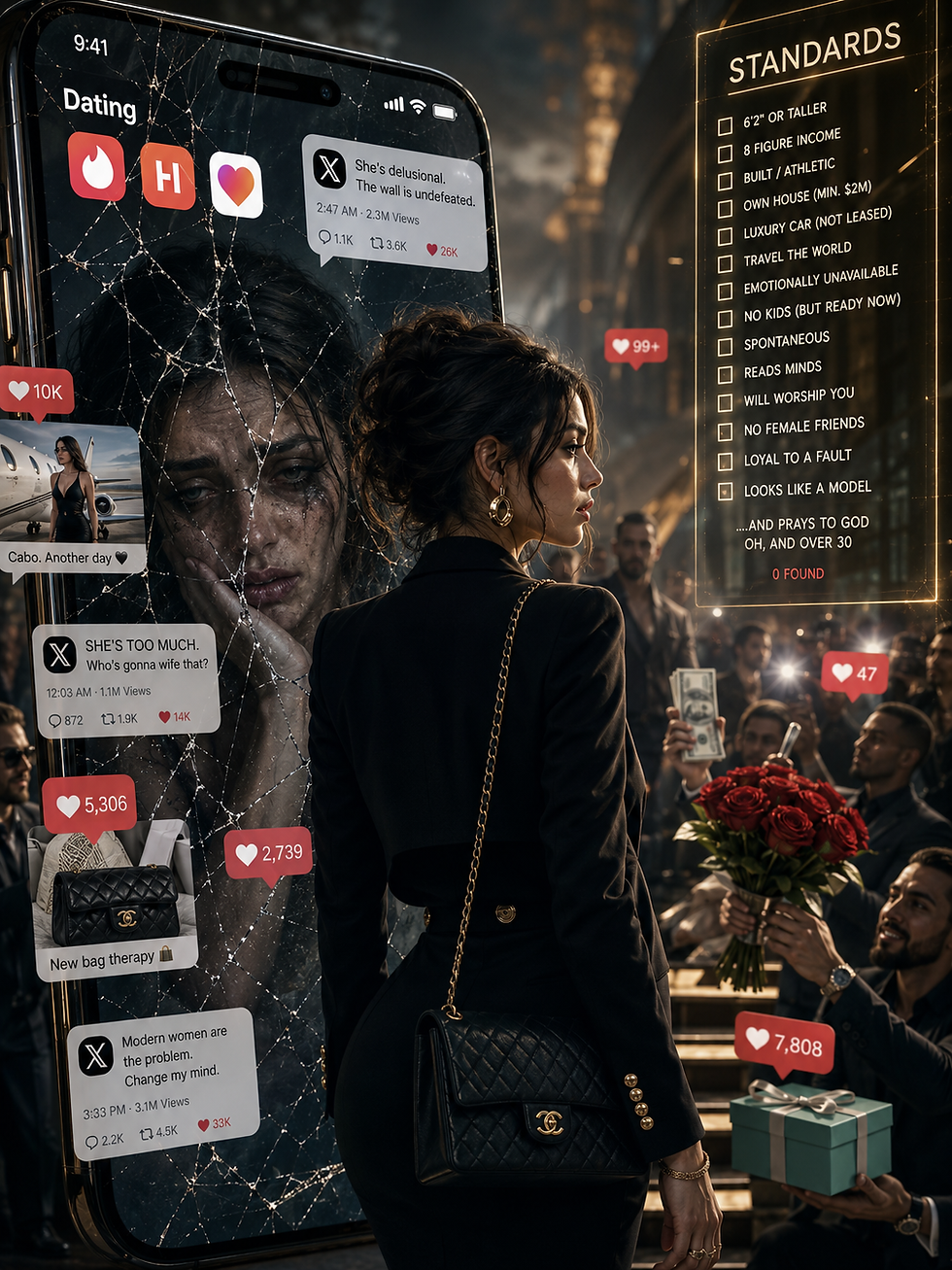
The High Preference Problem
There is a difference between having standards and having luxury expectations with starter-pack character. A woman saying she wants a disciplined, emotionally intelligent, financially stable, spiritually grounded, physically attractive, socially aware, ambitious, generous, masculine, soft-with-her-but-hard-on-the-world type of man is not automatically wrong. Wanting excellence is fine.
But here is the hypocrisy: if you want a built man, what have you built? If you want a disciplined man, where is your discipline? If you want emotional intelligence, can you handle feedback without turning into a courtroom drama? If you want a provider, are you building peace, partnership, and wisdom, or are you just expensive with lashes?
A lot of modern dating content sells women a fantasy where their preferences are sacred but their development is optional. That is the scam. It tells them, “You deserve more,” but never asks, “Are you becoming more?” It tells them, “Never settle,” but never asks, “Are you unbearable?” It tells them, “Raise your standards,” but never asks, “Can you meet the standard you are demanding?”
The audience eats it up because it feels good. It sounds empowering. It gets likes. It triggers men. It rallies women. It turns the comment section into a gender war. The creator wins. The audience gets dumber.
X Turned Dating Into Combat Sports
X, formerly Twitter, is one of the worst places for serious relational thought because the platform rewards sharp takes, humiliation, dunking, gender resentment, and rage-bait. The platform does not ask, “Is this wise?” It asks, “Will people react?” That difference matters.
Pew Research Center reported that many adults now use social platforms as part of their information environment, and its 2025 social media report shows how widespread these platforms remain across American life. YouTube, Facebook, Instagram, TikTok, Reddit, and X all shape how people package themselves, receive feedback, and perform identity in public.
Translation: the algorithm does not care if you are becoming wiser. It cares if you are reacting. So the most salacious dating posts win. “Women do not need broke men.” “Men are intimidated by standards.” “If he wanted to, he would.” “Never build with a man, wait at the finish line.”
That last one is the real disease. Professional development is about building. Modern dating-performance culture is about arriving after the building is done and calling that feminine energy. No, ma’am. That is not feminine energy. That is consumer behavior in a sundress.
Social Media Made Growth Look Boring

The reason this problem is so dangerous is because real growth does not always photograph well. Nobody wants to post the ugly middle. Nobody wants to post the unpaid internship season. Nobody wants to post the failed business. Nobody wants to post the cheap apartment. Nobody wants to post the therapy session where they realized they were the problem.
Nobody wants to post the moment they had to apologize without adding a “but.” Nobody wants to post the season where they had to sit down, shut up, learn, rebuild, and stop pretending they were healed just because they bought a new outfit and typed “soft life” under a picture.
But that is where development happens. Real professional growth is not a highlight reel. It is a boring, repetitive, unsexy catalog of fundamental change. It is showing up early. It is learning the skill. It is becoming coachable. It is getting corrected. It is taking responsibility. It is not confusing attention with impact.
Social media makes the opposite look powerful. It rewards the polished version, the dramatic version, the petty version, and the exaggerated version. Pew Research Center’s 2025 data shows that social media remains deeply woven into daily American life, with YouTube, Facebook, Instagram, and TikTok reaching huge shares of adults. That matters because dating culture now moves through platforms built for performance.
Instagram rewards beauty. TikTok rewards drama. X rewards conflict. LinkedIn rewards self-packaging. Put all of that together and you get people who know how to present growth better than they know how to practice it.
The Soft Life Without the Strong Mind
The soft life conversation started with a fair point: people, especially women, are tired of struggle, survival mode, overwork, bad relationships, and being expected to carry everything with no support. Fair. But like everything else online, the concept got hijacked.
Now soft life often gets marketed as: I should not have to struggle. I should not have to build. I should not have to compromise. I should not have to explain. I should not have to deal with a man who is not already finished. I should receive luxury because I exist.
That is not softness. That is fragility with a ring light. A soft life without a strong mind becomes entitlement. And entitlement is development’s natural enemy. Entitlement says, “I am owed.” Growth says, “I am becoming.” Entitlement says, “Where is my provider?” Growth says, “Where is my discipline?” Entitlement says, “He needs to match my energy.” Growth says, “Do I even understand my own energy?”
This is where the dating-performance archetype becomes dangerous. She does not just want love. She wants the optics of being loved by someone impressive. She wants the table, the trip, the flowers, the soft launch, the ring, the comments, the envy, and the “you deserve this, sis.”
But does she want the responsibility that comes with being someone’s peace? Does she want to be challenged? Does she want to be corrected? Does she want to build through the boring years? Does she want partnership when the man is still becoming? Often, no. Because the internet taught her that building with someone is embarrassing unless the final product looks expensive.
The Dating Market Has Become a Personal Brand War
Professional development teaches you to build value over time. Modern dating culture teaches some people to extract value before they have built much of anything. That is the nasty overlap. People are treating dating like LinkedIn clout: curated profile, inflated title, strategic language, selective storytelling, and no proof of actual transformation.
A woman can post about healing without being healed. She can post about standards without being stable. She can post about peace while being addicted to chaos. She can post about being a high-value woman while having low accountability, low patience, low self-control, and low ability to communicate without turning everything into a trial.
That is not high value. That is high maintenance with a Canva template. And because social media is built around visibility, not virtue, the loudest archetypes often become the teachers. The person who gets the most engagement gets treated like the person with the most wisdom. Terrible deal.
The result is a culture where people confuse audience approval with personal growth. A viral post is not maturity. A thousand likes is not discernment. A comment section full of “period” does not mean you are right. Sometimes it just means you found a crowd that shares the same blind spot.
Pretty Is Not Proof
Let us say the quiet part out loud. A lot of modern dating culture lets attractive people avoid development. Not always. Not everyone. But enough to talk about it. Beauty can become a bypass.
If a woman has always been complimented, gifted, pursued, forgiven, invited, desired, and treated as special because of how she looks, she may never be forced to develop the same internal muscles as someone who had to build from the floor. She may not know how to sit in rejection. She may not know how to process being told no. She may not know how to serve without applause. She may not know how to grow without being validated every five minutes.
That is not because she is a woman. That is because comfort can stunt anybody who never interrogates it. But in modern dating culture, the attractive female version of this gets heavily rewarded. The world tells her she is the prize before she has done the work to become a partner.
That creates a dangerous mismatch: high preference, low preparation. High demand, low development. High visibility, low self-mastery. And then everybody acts shocked when the relationship becomes chaos wearing perfume.
The Comment Section Is the New Groupthink Church
Social media has created little digital churches where people worship their own excuses. The sermon is a dating hot take. The choir is the comment section. The offering plate is engagement. And the gospel is simple: you are already perfect, and everyone else is the problem.
That is why accountability content struggles. Nobody wants to hear, “You may be the common denominator.” That does not feel good. That does not get shared as quickly. That does not let the audience feel superior.
But “men are intimidated by successful women” gets traction. “He is broke, leave him” gets traction. “You are the prize” gets traction. “Never build with a man” gets traction. It is easy. It is emotional. It is shareable. It gives people a villain. It lets them skip the mirror.
And that is the exact opposite of professional development. Professional development requires the mirror. Dating culture avoids it. Professional development asks, “What did I learn?” Dating culture asks, “Who can I blame?” Professional development says, “Feedback is data.” Dating culture says, “Feedback is disrespect.”
That is why the overlap is so important. The same mindset that ruins growth at work ruins intimacy at home. If you cannot receive correction from a supervisor without spiraling, you probably cannot receive correction from a partner without weaponizing tears, sarcasm, silence, or social media quotes.
The Real Danger: People Are Being Trained to Perform, Not Transform
The U.S. Surgeon General’s advisory on social media and youth mental health warned that certain types of social media use and exposure can raise mental health concerns. The advisory also noted that adolescents spending more than three hours per day on social media faced double the risk of poor mental health outcomes, including symptoms of depression and anxiety.
That does not mean social media magically ruins everyone. But it does mean the environment matters. And when the environment rewards comparison, performance, outrage, beauty, lifestyle flexing, public validation, and emotional overreaction, people start adapting to that environment.
They learn to post instead of process. They learn to brand instead of build. They learn to declare standards instead of develop standards. They learn to chase the appearance of being chosen instead of becoming someone worth choosing.
That is the exposé. Modern dating culture is not just changing relationships. It is changing what people think growth looks like. Growth now looks like a caption. Healing looks like a photoshoot. Confidence looks like arrogance. Standards look like a shopping list. Peace looks like avoidance. Luxury looks like love. Accountability looks like hate.
That is backwards as hell.
The Professional Development Lesson
Here is where the knife twists. The same woman who says, “I refuse to date potential,” may be demanding that the world date hers. Potential beauty. Potential emotional maturity. Potential communication. Potential loyalty. Potential discipline. Potential humility. Potential partnership.
But she wants a finished product while offering a construction zone. That is the hypocrisy.
Professional development does not work that way. No organization promotes you forever because you have potential. Eventually, you need performance. No leader keeps investing in you if you refuse feedback. No team trusts you if you collapse under pressure. No mission succeeds because somebody looks like they belong in the room.

You have to prove it. Dating should not be different. If you want excellence, become excellent. If you want stability, become stable. If you want leadership, respect process. If you want provision, understand sacrifice. If you want emotional intelligence, stop confusing emotional expression with emotional maturity.
Crying is not communication. Posting is not processing. Cutting people off is not always boundaries. Sometimes it is avoidance with better branding.
Final Word: The Internet Gassed You Up, But Life Will Grade You Anyway
The internet can make a person feel powerful while keeping them underdeveloped. That is the trap. It can tell a woman she is a queen while never asking if she knows how to govern herself. It can tell her she deserves luxury while never asking if she brings peace. It can tell her she is healed while she is still triggered by honesty.
It can tell her she is high value while her habits are low discipline. It can tell her not to settle while she has never learned how to build. And when that happens, modern dating becomes a performance, not a partnership. Professional development becomes branding, not transformation. Social media becomes a mirror that flatters instead of a tool that sharpens.
So yes, call it out. Call out the standards with no self-work. Call out the soft-life fantasy with no strong mind. Call out the high-preference dating culture that wants finished men but refuses unfinished seasons. Call out the X threads and TikTok clips that turn relational immaturity into empowerment slogans. Call out the pretty packaging with no growth inside.
Because beauty might get attention. But development keeps respect. And if the only thing someone has built is an audience, an aesthetic, and a list of demands, then let us stop calling that high value.
Call it what it is: a performance, a polished costume, and a loud brand with a weak foundation. Foundation always gets tested.
Source References
Pew Research Center. “Key findings about online dating in the U.S.” February 2, 2023. https://www.pewresearch.org/short-reads/2023/02/02/key-findings-about-online-dating-in-the-u-s/
Stanford Center for Teaching and Learning. “Growth Mindset.” https://ctl.stanford.edu/students/growth-mindset
U.S. Surgeon General. “Social Media and Youth Mental Health: The U.S. Surgeon General’s Advisory.” https://www.hhs.gov/sites/default/files/sg-youth-mental-health-social-media-advisory.pdf
Pew Research Center. “Americans’ Social Media Use 2025.” November 20, 2025. https://www.pewresearch.org/internet/2025/11/20/americans-social-media-use-2025/


Comments